

How to Specify Site Engineering Cover for a Long-Term Project
Specifying long-term site engineering well means being clear about four things: the scope of survey work, the deliverables you expect, the standards and tolerances that apply, and the resourcing and availability you need. The clearer you are on scope, equipment and the outcome you need, the more accurately we can price the day rate and resource the right engineer. Get those defined up front and you avoid the gaps that lead to rework, disputes and standing time later on a long programme.
For PMs, QSs and procurement teams across Hertfordshire, Essex, East Anglia and Cambridgeshire, a clear specification is what turns site engineering from a reactive cost into a controlled one. Here's what to include.
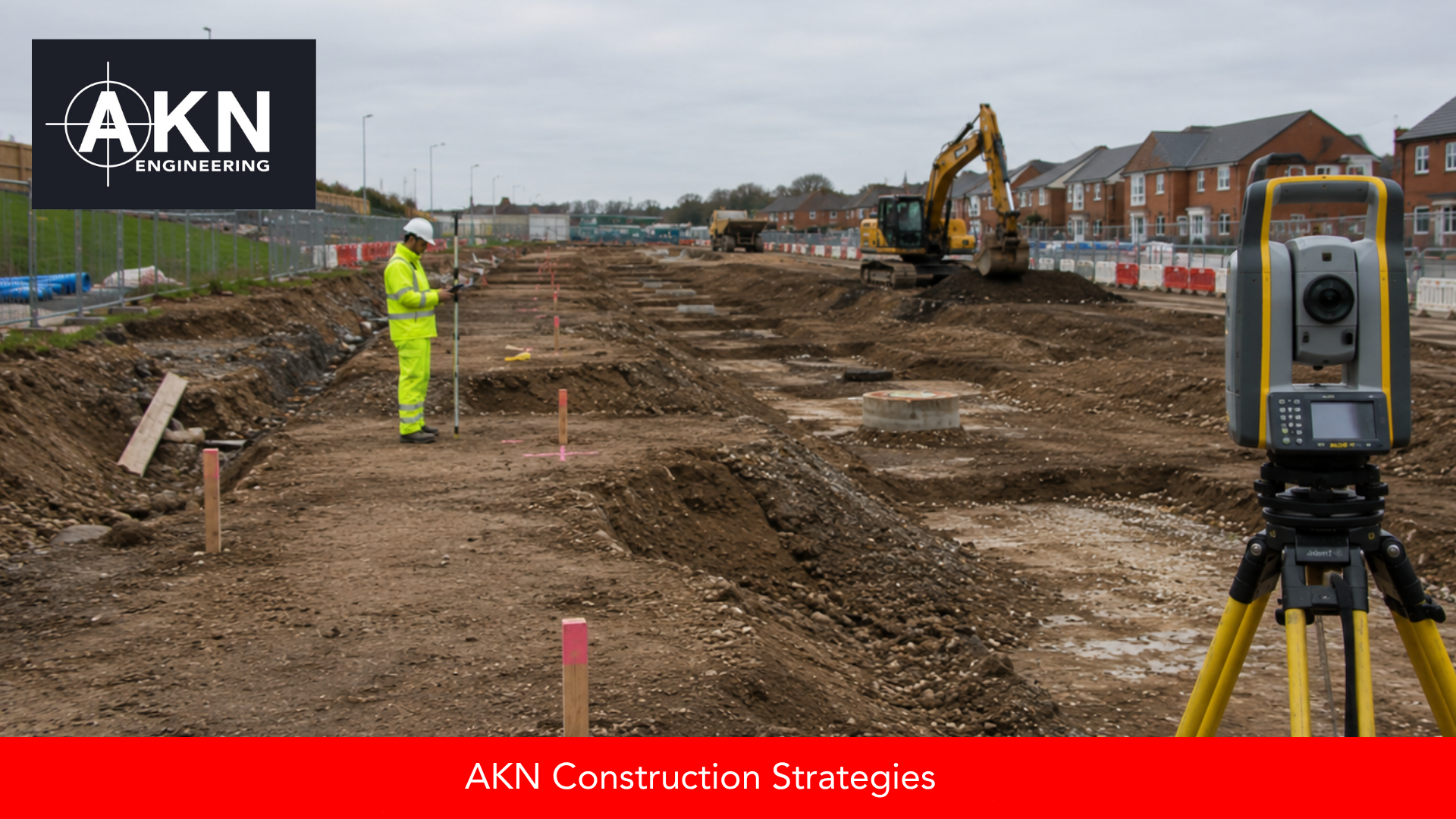
Site engineering on a long-term UK construction programme — AKN Engineering provides dedicated site engineering cover across Hertfordshire, Essex, East Anglia and Cambridgeshire.
What goes into a long-term site engineering specification?
At its core, a long-term site engineering specification covers the survey and setting-out work that runs through a project: establishing and maintaining the control network, setting out for groundworks, foundations, drainage and structures, transferring levels, independent checking, and producing as-built records. On a long programme it's continuous work, not a series of one-off visits — which is exactly why it's worth specifying properly.
Scope — be explicit about what's included
Control: establishing and maintaining the site control network to a defined standard.
Setting out: the elements to be set out — groundworks, foundations, drainage, structures, external works.
Verification: independent checking before key operations such as pours.
Records: the engineering register and as-built surveys as the works progress.
Deliverables and standards
Say what you expect to receive and to what tolerance. Setting out is typically worked to around ±5–10mm; where you need higher-accuracy verification or as-builts, 3D scanning to ±2–3mm may form part of the package. Specify the as-built format (CAD, point cloud or Revit) and confirm that a consistent engineering register is maintained throughout — it's the record that protects you at final account.
Resourcing and availability
This is the part most specifications leave vague, and it's where long programmes come unstuck. Decide whether you need a retained or directly employed engineer for continuity, or ad hoc cover for occasional tasks. Every day rate is built from the engineers needed, the equipment the work requires, and the outcome you're after — for example, a total station may be included in the price or charged separately depending on what you already have on site, and a specific instrument you request may need to be hired in at extra cost.
The more detail you give us on scope, equipment and outcome, the more accurately we can price it and resource the right engineer. For continuity, the same engineer holding the control network catches drift that rotating cover misses. Specify the level of cover — days per week or full-time for a phase — and the availability you need so the survey work stays ahead of the trades.
Common specification gaps
The usual gaps are unstated as-built requirements, no clear owner for the control network, tolerances left implicit, and availability that isn't guaranteed. Each of these surfaces later as rework, a dispute, or a rig or trade standing while an engineer is found. Closing them at specification stage costs nothing; leaving them open can cost a great deal.
The Institution of Civil Engineers publishes standards for survey control and setting out that a well-specified package should reference.
Working with AKN Engineering
AKN Engineering provides site engineering cover — retained or project-based, priced on a day rate — for main contractors and framework clients across Hertfordshire, Essex, East Anglia and Cambridgeshire. We'll help you scope the requirement properly: control, setting out, verification, as-builts and the right level of cover, all to a consistent standard with a single point of accountability
To scope the site engineering cover you need for a long-term project, speak to AKN Engineering.