

Do You Need a PAS 128 Utility Survey or Desktop Utility Search? (UK Guide)
Utility strikes are still one of the most common causes of delay, cost escalation, and health & safety risk on UK construction projects. If you’re planning civils, highways or groundworks, you’ve probably heard terms like “Desktop Search” and “PAS 128 Survey” — but working out which one you actually need isn’t always clear.
So in this guide, we’re breaking down the difference between a Desktop Utility Search and a PAS 128 Utility Survey, when each option is appropriate, and how they support safer decision-making on UK construction sites.

Desktop utility searches highlight recorded services — but real-world conditions can be very different. A PAS 128 utility survey helps confirm locations, reduce risk, and prevent costly strikes before you break ground.
What is a Desktop Utility Search?
A Desktop Utility Search (sometimes called a Utility Records Search or Desktop Study) compiles existing records from statutory undertakers and asset owners. These are the historic utility drawings held by electricity, water, telecoms and gas providers.
A Desktop Search provides:
Existing utility records (as-built drawings)
Plans showing approximate routes and positions
Information on asset ownership
Contact details for diversion enquiries
Records that can highlight potential constraints
A Desktop Search is not a survey and does not verify the physical location of buried services. It’s a paper-based investigation that informs feasibility, planning, and early design.
This aligns with early-stage investigation guidance found within UK procurement and infrastructure frameworks such as those managed by Crown Commercial Service, where records-based due diligence is standard in early design.
What is a PAS 128 Utility Survey?
A PAS 128 Utility Survey is a structured survey standard that defines how underground utilities must be detected, verified, and documented. It uses a combination of survey techniques including Electromagnetic Locators (EML), Ground Penetrating Radar (GPR), survey control, and positional accuracy checks.
PAS 128 surveys are carried out to different methodologies such as:
Type D – Desktop Records Search (the same as above)
Type C – Site reconnaissance and validation against visible surface features
Type B – Detection survey using EML/GPR
Type A – Physical verification (e.g., slot trenching)
PAS 128 also specifies confidence levels, which tell contractors how reliable the detected positions are.
This standard has become the benchmark for utility mapping in the UK and is referenced widely in the industry, including by bodies such as BSI (British Standards Institution) which publishes PAS specifications for industry adoption.
Desktop Search vs PAS 128 – Key Differences
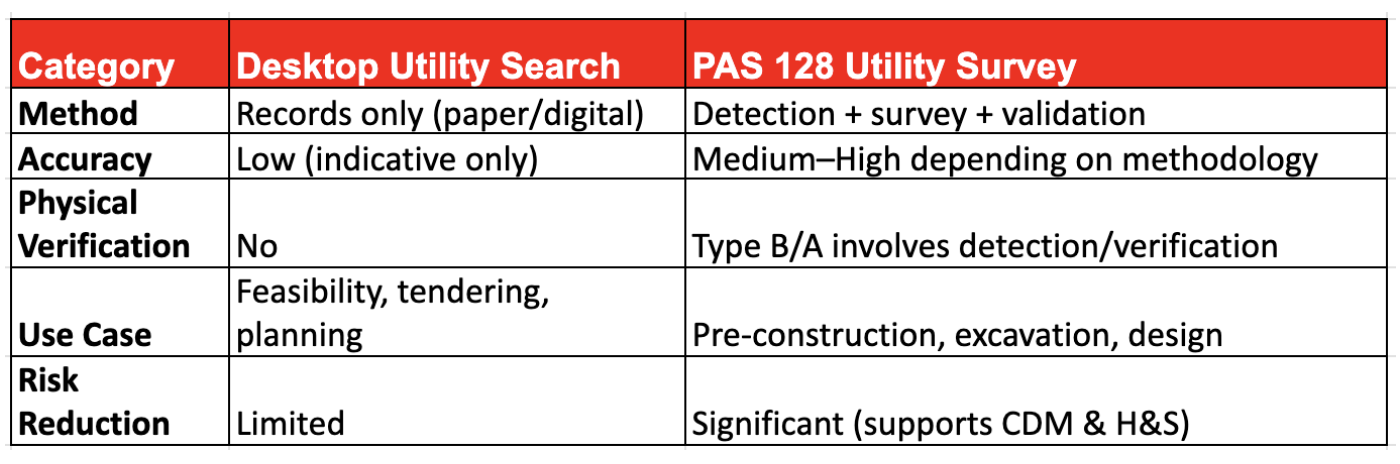
Desktop Search vs PAS 128 – Key Differences (Table format Summary)
When to Use Each Option on UK Projects
Use Desktop Utility Searches for:
✔ Early feasibility and design ✔ Tendering & cost planning ✔ Initial constraints mapping ✔ Planning submissions ✔ Understanding asset ownership
Desktop records are cheap and fast, which makes them ideal at RIBA Stages 1–2 and pre-tender stages.
Use PAS 128 Utility Surveys for:
✔ Excavation and groundworks ✔ Temporary works and shoring ✔ Drainage and utilities installation ✔ Highway works and public realm ✔ Avoiding utility strikes during construction
PAS 128 supports CDM risk management and aligns with the HSE’s emphasis on preventing contact with underground services under HSE construction guidance.
How Long Are GPR Surveys and Desktop Searches Valid For?
This is one of the most common questions we hear on UK projects, and the honest answer is:
There is no fixed legal expiry date — validity depends on risk, ground activity, and project stage.
But there are sensible industry rules that most contractors follow.
Desktop Utility Search (Type D) – Typical Validity
A Desktop Utility Search is normally considered valid for around 3–6 months, provided:
✔ no major works have started on site ✔ the area hasn’t been excavated or resurfaced ✔ no new connections or diversions are known ✔ the project hasn’t moved from design to construction
Once groundworks begin, records alone quickly become unreliable. Asset owners update drawings at different times, and not every change makes it back into the record set.
Practical rule: If your Desktop Search is more than 6 months old by the time you break ground, it should be refreshed.
PAS 128 GPR / Type B Survey – Typical Validity
A PAS 128 detection survey is usually treated as valid for 3 months — sometimes less — because it represents:
the ground condition
at a specific time
before excavation or disturbance
After any of the following, the survey should be repeated:
✔ trenching or bulk excavation ✔ new utility installations ✔ heavy trafficking or resurfacing ✔ long programme gaps ✔ design changes affecting alignment
Practical rule: If there has been any intrusive work since the GPR survey, assume it needs updating.
Using out-of-date information can undermine:
risk assessments
method statements
permit to dig processes
insurance positions after a strike
That’s why most principal contractors treat utility information as a living record, not a one-off report.
Our Approach on Projects
We normally advise:
Desktop Search at feasibility
PAS 128 GPR before excavation
Refresh if >3 months old or ground disturbed
Targeted re-survey where design changes occur
This keeps investigations proportionate without creating unnecessary cost.
Do You Need Both?
On most infrastructure projects, yes — because they answer different questions:
Desktop Search = What should be there?
PAS 128 Survey = What is actually there, and where?
If you’re breaking ground, a Desktop Search alone is almost never sufficient from a risk perspective.
Why This Matters for Contractors, PMs & QSs
Understanding the difference influences:
Programme (avoiding delays and redesigns)
Commercials (avoiding claims and variations)
Health & Safety (preventing strikes and incidents)
CDM compliance (competent planning and investigation)
Skipping PAS 128 may save money short-term but creates latent risk that often appears during groundworks — the worst possible time operationally and commercially.
How We Support Clients
We support contractors, designers and subcontractors with:
Desktop Utility Searches (Type D)
PAS 128 (Type C & Type B) surveys
Confidence level reporting
GPR and EML detection
Survey control & topographical context
As-built records & CAD deliverables
We also provide advice on what level of investigation is proportionate for the project stage, scope and excavation risk.
Desktop Utility Searches and PAS 128 Utility Surveys serve different purposes. One informs early design and planning; the other supports safe excavation, construction, and compliance. Most projects need both — just at different stages.
👉 www.aknengineering.co.uk or call us on 01279 927 033 ☎️ to discuss your next project.