

How Accurate Is a Total Station on UK Civils Projects?
On UK civils projects, a modern total station typically achieves millimetre-level accuracy — commonly ±2–3mm for distance and angular measurements under proper control conditions. However, real-world accuracy depends far more on survey control, setup method, ground stability, and operator competence than on the instrument specification alone. In practice, control verification matters more than brand marketing.
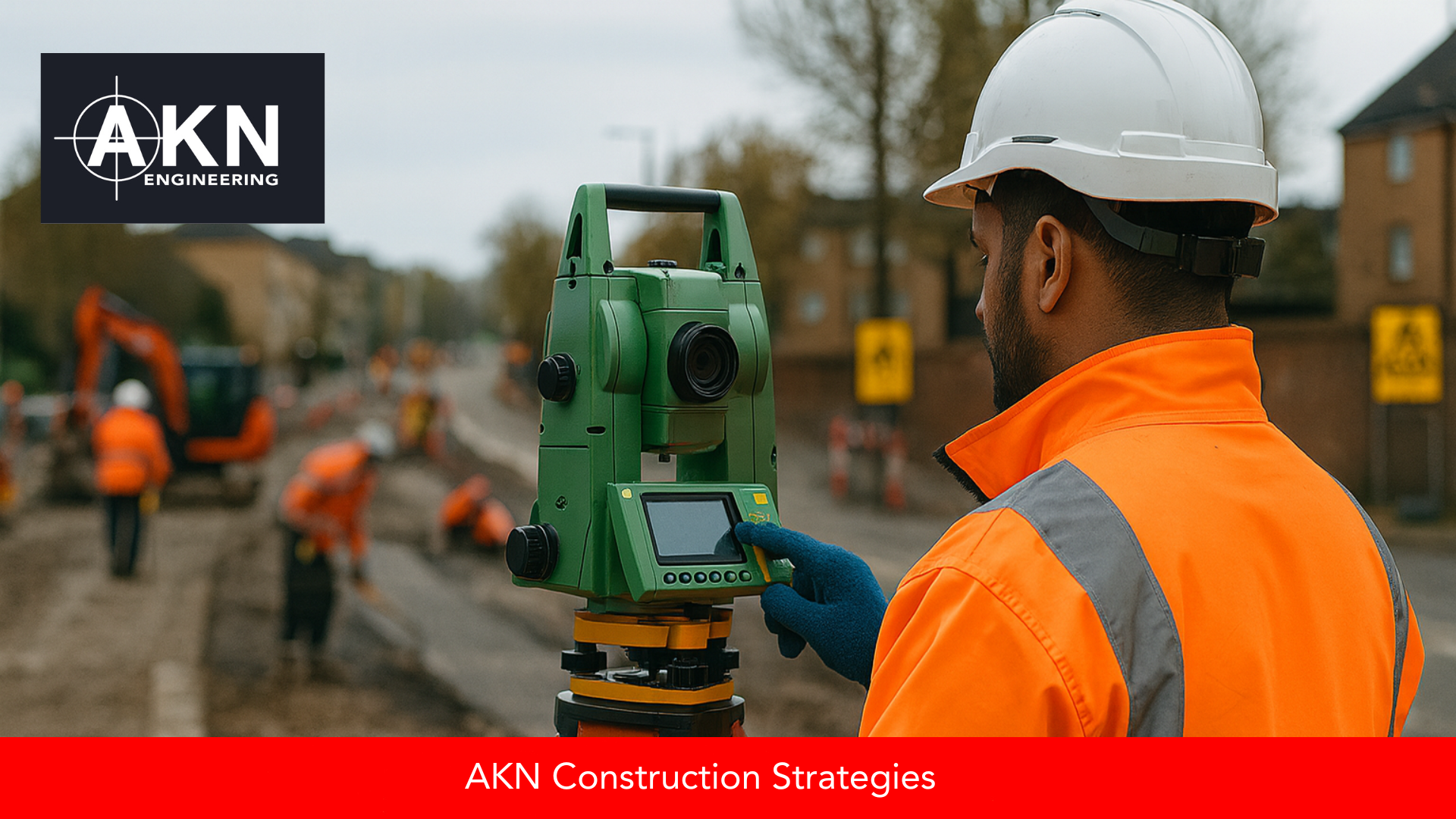
AKN Engineering Site engineer carrying out precision setting out using a total station on a UK highways project, where accuracy and control are critical to achieving design tolerances and compliant construction.
What Does “Total Station Accuracy” Actually Mean?
Manufacturers publish accuracy as:
Angular accuracy (e.g. 1″, 2″)
Distance accuracy (e.g. ±2mm + 2ppm)
But those numbers assume:
Stable instrument setup
Verified control
Clear line of sight
Controlled environmental conditions
On live civils and highways sites, those assumptions don’t always hold.
What We See on Highway Works
On Section 278 and Section 38 schemes across Hertfordshire, Essex and Cambridgeshire, the biggest accuracy issues don’t come from the instrument — they come from:
Inherited control never checked
Disturbed benchmarks
Coordinate systems not confirmed in writing
Rushed setups before pours
We regularly see tolerances missed not because the total station was wrong — but because the control was.
Highway works delivered under standards and local authority specifications often require tolerances tighter than general building work.
For example:
Kerb lines and alignment tolerances
Drainage invert levels
Pavement build-ups
Tie-ins to existing carriageway
The Institution of Civil Engineers reinforces that competence in survey control is central to reliable delivery — not optional.
Where Accuracy Is Lost on Site
Even with a 1″ total station, accuracy degrades when:
✔ Control points move
✔Tripods aren’t properly stabilised
✔ Prism constants aren’t checked
✔ Wrong coordinate systems are used
✔ Atmospheric corrections are ignored
✔ Multiple packages extend control differently
Accuracy isn’t just about millimetres — it’s about consistency across the scheme.
Total Station vs GNSS – When It Matters
Total stations are preferred when:
Working under structures
Achieving tight kerb or drainage tolerances
Tying into existing infrastructure
Working where GNSS signal is unreliable
GNSS is efficient for:
Bulk earthworks
Open groundworks
Rapid topo surveys
Both require verified control. Neither fixes bad setup.
Limitations & Honesty
A 1″ instrument does not guarantee 1mm site accuracy
Survey tolerances depend on verified control
Environmental factors affect precision
Poor coordination between packages introduces error
The HSE construction guidance makes clear that competence and proper planning are essential in construction delivery — survey control forms part of that foundation.
How We Approach Accuracy on Site
We focus on:
Verifying primary control before use
Confirming coordinate systems in writing
Protecting benchmarks physically
Cross-checking critical points
Making survey verification part of ITR hold points
Accuracy is protected by process, not just equipment.
Main Contractor Questions
Is a total station accurate enough for highway works?
Yes — when control is verified and setup is correct.
Should control be checked even if provided by the designer?
Yes. Always verify before relying on it.
What causes most tolerance disputes?
Unverified or inconsistently extended control networks.
👉 In need of support? Visit www.aknengineering.co.uk or call us today on:
☎️ 01279 927 033 for a no obligation discussion about your upcoming projects.